
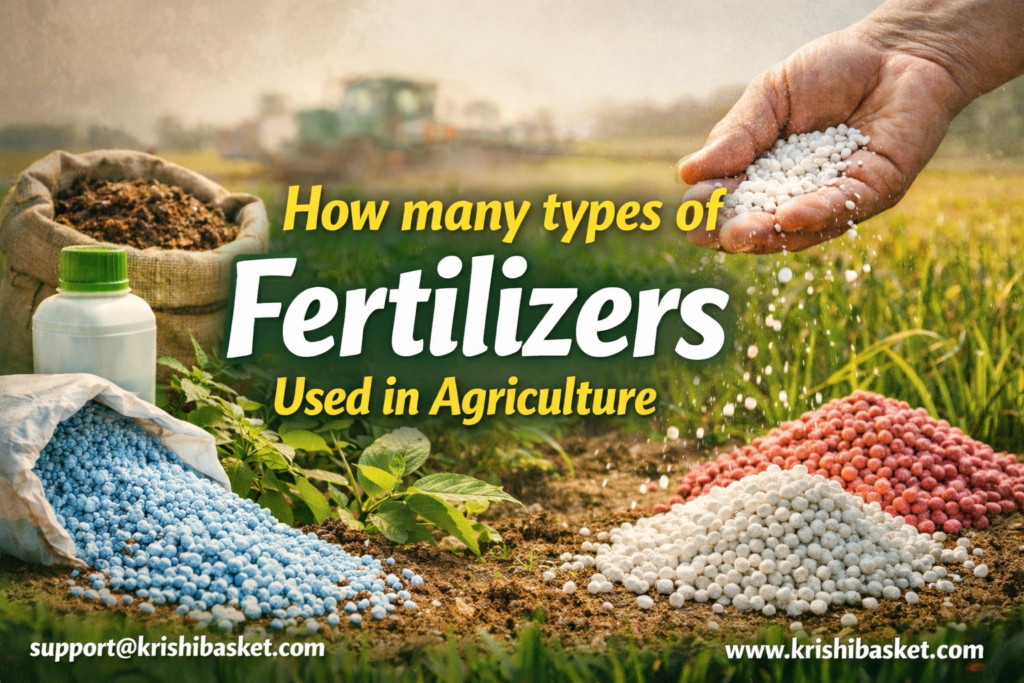
How Many Types of Fertilizers Used in Agriculture
In India, farmers grow a wide variety of crops depending on soil type and climate. Over the years, the use of fertilizers has increased significantly because different crops require different nutrients, and soils gradually lose fertility after repeated cultivation. According to FAI, India used about 601 lakh metric tonnes of fertilizers in 2023–24, which shows how important fertilizers are for maintaining crop productivity.
Crops such as paddy, wheat, sugarcane, cotton, and pulses need proper nutrition throughout their growth cycle. Fertilizers act as growth boosters by strengthening roots, improving plant health, and enhancing grain quality—helping farmers achieve good yields even when weather conditions are challenging.
In this guide, we’ll explore the common types of fertilizers used in Indian agriculture, how they work, their benefits, and how to choose the right one.
What Are Fertilizers?
Fertilizers are natural or manufactured substances that provide essential nutrients to plants. They are available in granular, powder, or liquid form and help restore nutrients that soil loses after continuous cropping.
Most fertilizers contain three key nutrients:
- Nitrogen (N) – supports leafy growth
- Phosphorus (P) – helps root development
- Potassium (K) – improves plant strength and quality
These are known as NPK nutrients, and together they play a major role in healthy plant growth. When crops grow, they absorb nutrients from the soil. Over time, this depletes soil fertility, and fertilizers help replenish those lost nutrients.
How Do Fertilizers Work?
Fertilizers release nutrients into the soil after application. Plant roots absorb these nutrients depending on soil moisture and fertilizer type, and then distribute them throughout the plant.
Each nutrient has a specific role:
- Nitrogen keeps leaves green and promotes growth.
- Phosphorus encourages strong roots.
- Potassium strengthens stems and improves grain quality.
When balanced properly, these nutrients improve plant metabolism and support faster, healthier growth. That’s why selecting the right fertilizer is essential for good yields.
Why Fertilizers Are Important
For farmers, gardeners, and growers, understanding fertilizer importance is key to successful cultivation. In India’s varied soils and climates, fertilizers make a noticeable difference.
They:
- Restore nutrients lost after continuous cropping.
- Promote strong roots, sturdy stems, and healthy fruits.
- Maintain soil productivity for future crops.
- Improve overall yield and farm returns.
However, relying only on chemical fertilizers without organic matter can gradually reduce soil quality, so balance is important.
Types of Fertilizers Used in Agriculture
Fertilizers are mainly divided into organic and inorganic types. They may supply major nutrients (NPK) or small but essential micronutrients such as zinc, iron, and boron.
1. Organic and Bio-based Fertilizers
These come from natural sources such as compost, farmyard manure, crop residues, green manure, and animal waste. They release nutrients slowly but improve soil health over time.
Benefits
- Improve soil structure
- Increase water-holding capacity
- Encourage beneficial microbes
- Safe for the environment
- Maintain long-term soil fertility
They are especially useful for crops that benefit from gradual nutrient release.
2. Inorganic or Chemical Fertilizers
These fertilizers are manufactured using minerals and chemical processes. They provide nutrients quickly and are useful when crops need immediate nutrition.
Advantages
- Provide exact nutrient quantities
- Easy to measure and apply
- Highly concentrated (small amount gives strong results)
- Suitable for large-scale farming
3. Micronutrient and Specialty Fertilizers
Plants also need small amounts of micronutrients for proper growth. Without them, crops may appear weak, pale, or produce fewer fruits and grains.
Common micronutrients:
- Zinc: improves grain formation
- Iron: supports photosynthesis and green leaves
- Boron: helps flowering and fruit setting
- Manganese & Copper: strengthen resistance to stress and disease
Specialty fertilizers are advanced products designed to release nutrients slowly, reduce wastage, and improve absorption. Many are water-soluble or come in coated or nano forms for efficient delivery.Examples include urea, DAP, and potash.
How to Choose the Right Fertilizer
Two farmers may use the same fertilizer but get different results. The difference often lies in choosing the right fertilizer for soil and crop needs.
Tips for selecting the right fertilizer
- Start with a soil test to know nutrient requirements.
- Match fertilizer type to the crop growth stage
- Nitrogen for early growth
- Phosphorus and potassium for flowering and fruiting
- Use slow-release fertilizers for sandy soils and lighter doses for clay soils.
- Combine organic and inorganic fertilizers for balanced results.
- Always follow recommended dosage and timing.
Conclusion
Fertilizers play a crucial role in supporting India’s diverse agriculture. They don’t just increase yields—they also help maintain soil health when used correctly. The best approach is a balanced one: regular soil testing, understanding crop nutrient needs, and combining organic matter with NPK and micronutrients.
With the right fertilizer strategy, farmers can grow healthier crops, improve quality, and keep their soil productive for years to come.
No Comments